Democratic Governor Maura Healey signed in a new law expanding abortion all the way until birth in the state of Massachusetts. The previous law prohibited abortions after 24 weeks.
Massachusetts has joined Alaska, Colorado, Maryland, Michigan, Minnesota, New Jersey, New Mexico, Oregon, Vermont and the District of Columbia in allowing the procedure until birth.
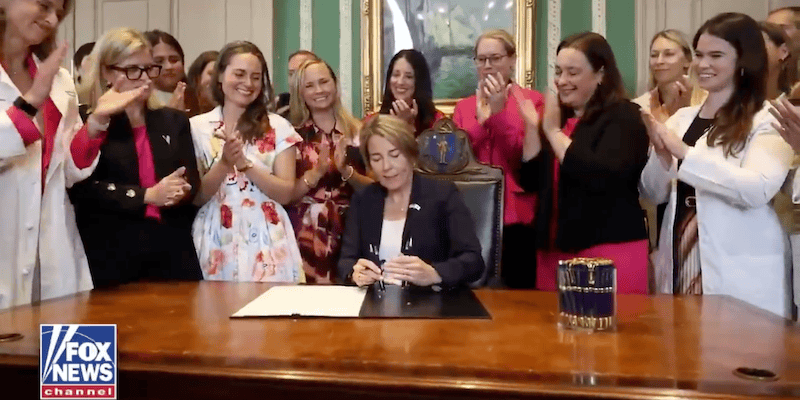
Democratic Gov. Maura Healey was met with applause and smiles as she signed away Massachusetts’ gestational limits on abortion, making the deep-blue state the 10th to permit the procedure up to birth.
Under the Prioritizing Patient Access to Care Act, health care workers will have greater discretion in determining whether to perform an abortion later in pregnancy, without facing legal penalties under the state’s previous restrictions.
Healey said the law is intended to ensure families facing medical complications late in pregnancy can abort their babies in Massachusetts rather than having to travel out of state. Those complications can include maternal health complications and fatal diagnoses.
Source: Fox News
The pro-abortion Healey believes that this is a “shield” against pro-life policies, especially after the Supreme Court’s Dobbs decision that overturned Roe v. Wade.
“We believe that health care decisions should be made between women and families and their doctors, not politicians,” said Healey, adding, “Abortion will remain safe. It will remain legal, and it will remain accessible here in Massachusetts. That’s my commitment to you.”
Here are the ghouls celebrating the new law:
A blue state just legalized abortion up until birth.
Surrounded by applauding women, Massachusetts Gov. Maura Healey signed a sweeping abortion bill Monday that removes the state’s gestational age limit, giving health care providers greater discretion to perform abortions later… pic.twitter.com/ZtDIgWwVMC
— Fox News (@FoxNews) August 11, 2026
Late-term abortion is a horrific procedure that involves the killing of the child in the womb, sometimes by dismemberment.
SBA Pro-Life America President Marjorie Dannenfelser condemned the signing of the “egregious” law in a statement Monday, arguing that late-term abortions can involve dismemberment of the fetus.
“It should shock the conscience that tens of thousands of unborn Americans are barbarically dismembered limb by limb and torn apart every single year,” she said. “Sadly, that number will only increase with Gov. Healey’s approval of the Abortion Up Until Birth Bill. The GOP must abandon the ‘leave it to the states’ position – a stance that permits egregious late-term abortion laws like this one – and advance national protections for unborn children.”
Source: Fox News
While pro-abortion politicians like Gov. Healey, activists, and the Partisan Presstitutes push the claim that late term abortion is almost exclusively performed because the unborn child has a fatal birth defect or the mother’s life is at risk, the facts don’t bear that out.
According to the pro-life Charlotte Lozier Institute:
Media coverage of abortions in the final months of pregnancy often focuses on abortions performed because the unborn baby has a very serious health condition. However, research shows that many late-term abortions are performed for the same reasons as abortions earlier in pregnancy.
A qualitative analysis of interviews with 28 women who obtained abortions between 24 and 35 weeks identified two “pathways” that led women to seek an abortion late in pregnancy.[8] The first pathway involved receiving new information—this included both women who learned their unborn baby had an abnormality and those carrying healthy babies who were unaware of their pregnancy until a later stage. The second pathway involved obstacles that delayed access to abortion, such as cost, among other barriers. Although some women referenced prenatal diagnosis of fetal abnormalities as a factor in their decision, the author clarified that “[t]he new information respondents received that led to their decision to obtain an abortion was not exclusively related to fetal health.” The author concluded that reasons for abortion late in pregnancy are similar to reasons for earlier abortions, and that “despite the enumerated ways that third-trimester abortion differs from earlier abortion—in clinical complexity, cost, logistics, and social support—there are clear consistencies in why people seek abortion care, regardless of gestation.”…
…According to research published by a former Colorado abortion center that specialized in late-term abortions, fewer than one-third of abortions performed between 2007 and 2012 were carried out on babies with health conditions, suggesting that most abortions were performed on healthy babies.[12] Of the unborn babies aborted because of a prenatal diagnosis, the most common health condition was Down syndrome, a condition which in most cases does not present a lethal threat to the child. In fact, most children with Down Syndrome go on to lead happy, fulfilling lives.[13] While the aforementioned study did not indicate the exact gestational ages at which abortions unrelated to a prenatal diagnosis were performed, another study published by the same abortion center reported that of over one thousand abortions performed between 18 and 38 weeks, only a fifth were performed because the unborn baby had a poor prenatal diagnosis.[14]
Source: Charlotte Lozier Institute Emphasis added
One study that was once posted on the pro-abortion Guttmacher Institute website admits that the reasons women get a late term abortion aren’t that different from the ones who opt for a first-trimester abortion.
One caveat to note: This study deliberately excluded women who had an abortion due to “fetal anomaly” (which may include Downs Syndrome, the study isn’t clear on that,) or endangering the life of the mother, but if those are excluded, according to advocates, there should be no women seeking late-term abortion to study, right?
Most women seeking later abortion fit at least one of five profiles: They were raising children alone, were depressed or using illicit substances, were in conflict with a male partner or experiencing domestic violence, had trouble deciding and then had access problems, or were young and nulliparous…
…In many ways, women who had later abortions were similar to those who obtained first-trimester procedures. The two groups did not differ by race or ethnicity, number of live births or abortions, mental or physical health history, or substance use…
…In contemporary discussions of later abortion, few empirical data exist about the women who seek these procedures, but speculation abounds, including the presumption that these women are intrinsically different from those seeking early abortions. Despite this common narrative, women in our study who obtained first-trimester abortions and women who obtained abortions at or after 20 weeks’ gestation were remarkably similar. Demographically, the only significant differences between the two groups were in age (women aged 20–24 were more likely than women aged 25–34 to seek later abortion) and in employment status (employed women were less likely than unemployed women to have later abortions).
Source: Perspectives on Sexual and Reproductive Health (Wiley Online Library) Emphasis added
Pro-life advocates should understand that the repealing of Roe didn’t mean the end of the fight for life, it just meant that the battle lines were redrawn. This was no longer a fight on the national level over a bad legal decision, it is now a fight at the state level to protect the lives of the innocent.
Don’t give up the fight, Bay Staters!